Consecutive 5ths and Octaves
When two parts form a harmonic interval of a perfect 5th, this should not normally be followed by another perfect 5th between the same two parts, in Classical harmony. This …
Pass Your Music Theory Exam with Confidence!

When two parts form a harmonic interval of a perfect 5th, this should not normally be followed by another perfect 5th between the same two parts, in Classical harmony. This …
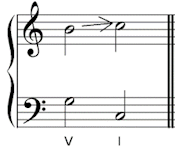
Voice Leading Leading Notes The behaviour of the leading note is crucial to writing good harmony, and good compositions. The 7th degree of the scale is called the “leading note” …
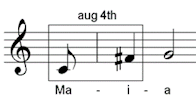
Aug/Dim Melodic Intervals If the interval between one note and the next in a tune is an augmented or diminished interval, the interval is dissonant and needs to be treated …
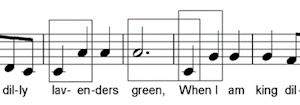
Conjunct Motion Stepwise movement is called “conjunct” movement and is the most common type of movement found in all styles of music. Conjunct movement is the easiest to sing, and …
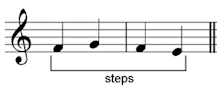
What is Voice Leading? The term “voice-leading” refers to the way a line of music moves up and down. (It is also sometimes called “part-writing”.) Voice-leading helps us to answer …

A “pedal” is a note which is repeated or held for some time, while the chords around it change. Pedals are normally found on either the tonic or dominant notes. …
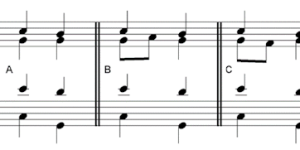
Ordinary Auxiliary Notes Auxiliary notes are non-chord notes which are approached and quit in the opposite direction by step. They are usually unaccented. Auxiliary notes occur between two chord notes …
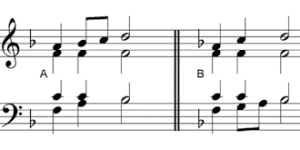
Accented passing notes fall on the beat, instead of between the beats. Here are some undecorated chords. There are thirds in the soprano part which could be decorated with unaccented …
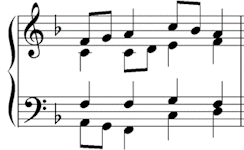
Passing notes are non-chord notes which are approached and quit by step in the same direction. They can be either accented or more usually, unaccented. Unaccented passing notes are the …

Normally at the end of a phrase we find some type of cadence. If chord V (or V7) is used as the penultimate chord, the final chord of the phrase …