Last Updated on 1 November 2026 by Victoria Williams
Pass Your Grade 8 Music Theory with Distinction!
ABRSM Grade 8 Theory Video Course
Grade 8 is the final level of music theory offered by the ABRSM as an examination subject. (Higher diploma levels are available from Trinity however).
At this level, you are studying topics similar to those studied at undergraduate level at a UK university.
View ABRSM Grade 8 Music Theory Video CourseLearn at home at your own pace, with a structured course in logical order!
Also Available…

ABRSM Grade 8 Theory Syllabus
As in the preceding grades, with the addition of:
- The harmonic vocabulary will include all standard diatonic and chromatic chords.
- Questions will cover:
- Continuation of a given opening of a passage from a Baroque trio sonata for two treble instruments and basso continuo. The basso continuo part will be given throughout and fully figured (but a realisation for keyboard will not be required).
- Completion of an outline of a short passage for keyboard. Some knowledge of the styles practised by composers from the time of Haydn onwards will be assumed.
- Continuation of a given opening of a melody for a specified instrument (a choice will be given).
- Questions on short extracts of music written for piano or in open score for voices or for any combination of instruments and/or voices, designed to test the candidate’s knowledge of the elements and notation of music, including the realization of ornaments, the identification and notation of underlying harmonic structure, phrase structure, style, performance, and on the voices and instruments for which the works were written.
Read the ABRSM music theory syllabus here.
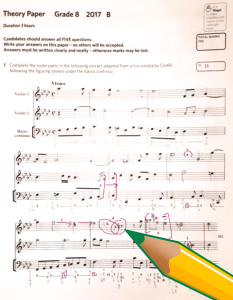
Get a Free Grade 8 Practice Test PDF!About ABRSM Grade 8 Music Theory
Grade 8 tests your knowledge and skills in harmony, composition and general knowledge through a variety of questions.
The exam begins with a Baroque Trio Sonata, which needs to be completed according to the instructions in the figured bass and should conform to the typical Baroque style. This question tests your ability to interpret the figuring, to notice patterns and sequences and apply them appropriately elsewhere, and to obey the rules of harmony that were practised during the Baroque period.
Question 2 requires you to complete a keyboard piece from the given skeleton framework, usually from the Romantic era. You are provided with example bars and harmony, and are tested on your ability to write in the same character throughout, while still obeying the conventions of harmony and in an appropriate keyboard style.
The third question in the exam is a composition piece. You will be given the opening melodic ideas of two pieces and need to choose one to continue into a fully formed piece. You will be tested on your ability to adapt the given opening, fitting a strong melody to a good harmonic framework built of phrases and cadences, as well as writing in an idiomatic style suitable for the instrument. You will be expected to structure the composition in a logical manner, and to include changes of key.
The final two questions in the exam use musical scores to test a wide range of general knowledge questions in music theory. Usually you will be presented with one score for a chamber work, such as a sonata or string quartet, and another for a larger orchestral work. Questions normally cover a variety of topics such as chords, key and harmony, intervals, transposition, knowledge of notation, special symbols and foreign terms, style and compositional techniques, and knowledge of the standard and extended orchestral families.
Grade 8 is a challenging exam, but one which you will find interesting and useful. The skills you learn at this level will help you to make sense of a large variety of music as both a listener and a player, and for those who are interested in composition, there are plenty of techniques covered to help you extend your skillset.
For more information about the ABRSM exams in general, visit www.abrsm.org
Free ABRSM Grade 8 Music Theory Lessons on MyMusicTheory.com
Borrowed Chords and Parallel Keys
Suspensions (3-Part Figured Bass)
Trio Sonatas – Roots, Thirds and Fifths
Keyboard Reconstruction – Introduction
Keyboard Reconstruction – Working with the Harmony
Keyboard Reconstruction – Using 2nd Inversions
Keyboard Reconstruction – Texture and Part-writing
Keyboard Reconstruction – Voice Leading and Consecutives
Keyboard Reconstruction – Notation
Keyboard Reconstruction – Phrases, Patterns and Sequences
Keyboard Reconstruction – Writing Alberti Bass
Composition – Analysing the Given Opening
Composition – Creating a Structure
Composition – Adapting a Melodic Idea
ABRSM Grade 8 Music Theory Test
View the Complete Grade 8 Music Theory Video Courses