The Baroque Era
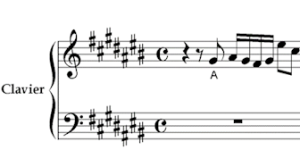
The Baroque Era The Baroque era in music was (roughly) between the years 1600 to 1750. Some of the most famous composers of this era are: J.S. Bach, Henry Purcell …
Pass Your Music Theory Exam with Confidence!
The Baroque Era The Baroque era in music was (roughly) between the years 1600 to 1750. Some of the most famous composers of this era are: J.S. Bach, Henry Purcell …

Pivot Chords A pivot is a chord which belongs to both the old and new keys. Pivot chords can make modulations smoother, but it is not essential to use a …

Prevailing Key The key at the start of a piece of music is the “home” key. Music can change key for brief moments, or for longer passages. When there’s a …

Close Keys for Modulation Whichever key you begin with, the closest keys to modulate to are the dominant (add one sharp or remove one flat), the subdominant (add one flat …
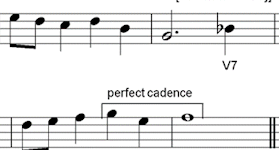
Modulation “Modulation” in music means “change of key”. A modulation can happen with or without a change of key signature, and in fact, most modulations do not include a change …

Figured Bass Accidentals If a chord needs an accidental, a flat, sharp or natural sign is added as a figure. It is either written next to the number it applies …
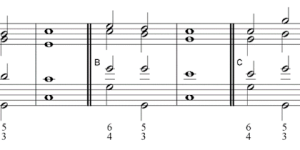
5/3 – Root Position Chords 5/3 means “root position chord”, or “a” chord. We must add a 5th and a 3rd above the bass note to make a complete chord. …

Figured Bass – Introduction Figured bass is a 17th-18th century system for notating improvised chords, which is used in modern times as a tool for music theory and analysis (so, …

Here is an SATB hymn tune Pansies, Lilies, Roses which is not decorated: To make it a little more rhythmically and melodically interesting, we can add unaccented passing notes between …

The four voices in SATB writing have different characteristics. In fact, 4-part music has three separate layers. The topmost layer is the tune, found in the soprano part. The lowest …