Last Updated on 23 May 2026 by Victoria Williams
Pass Your Grade 3 Music Theory with Distinction!
Trinity Grade 3 Theory Video Course
Expand your music reading skills with more complex note values and time signatures and notes high above or below the stave.
Discover the dominant triad and how chords work together to make cadences.
See the full syllabus below!
The course includes around 1 hour of short video lessons (2-4 minutes each), plus PDF with answers included.
View Trinity Grade 3 Music Theory Video CourseAlso Available…
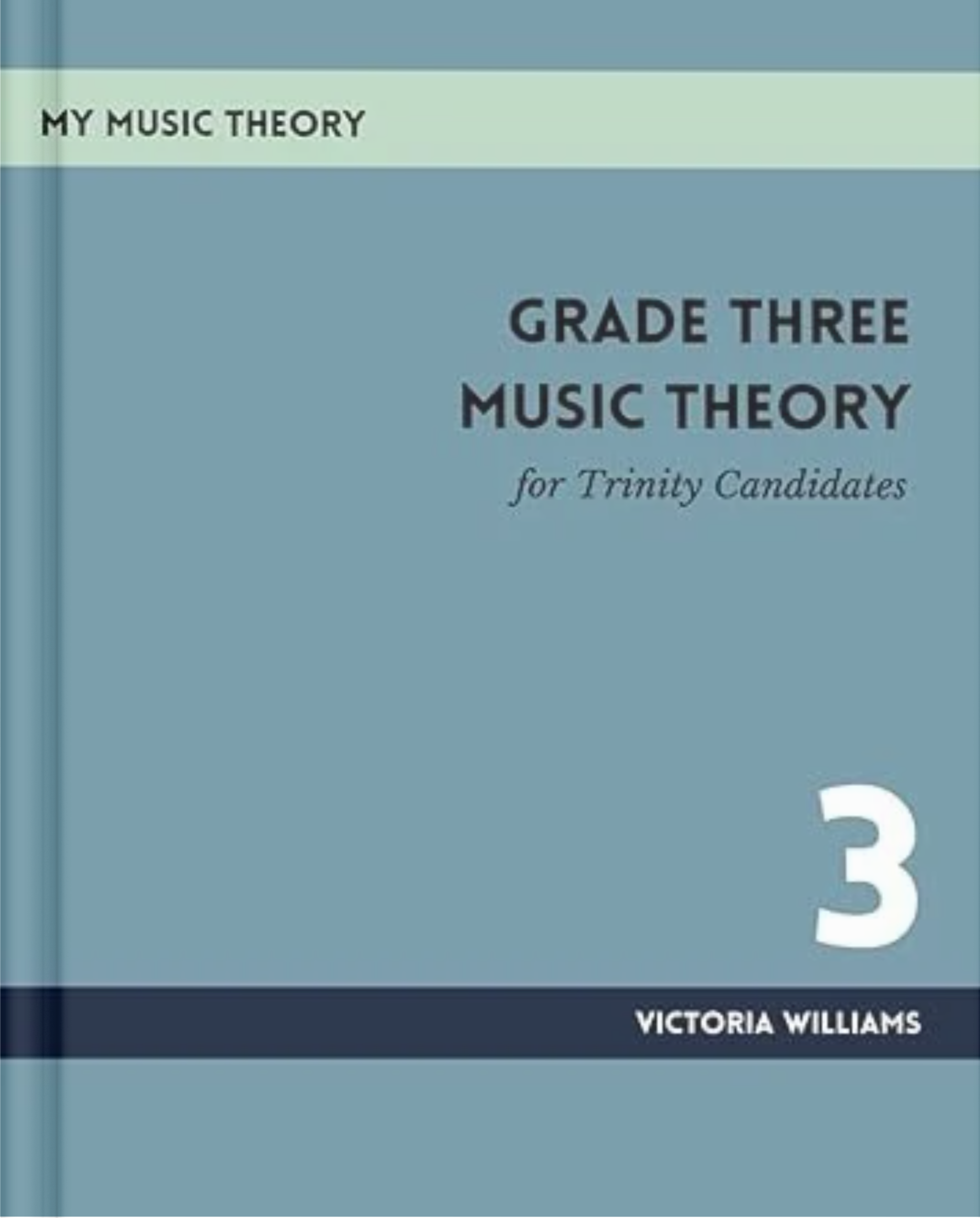
Trinity Grade 3 Theory Syllabus
As in the preceding grades, with the addition of:
Rhythm
- Compound time (time signatures of 6/8, 9/8 and 12/8 )
- Grouping semiquavers and semiquaver rests in simple and compound time (16th notes and rests)
- Dotted quavers and dotted quaver rests in simple and compound time (dotted 8th notes)
- Rules for grouping note and rest values within 6/8, 9/8 and 12/8 time signatures
- Quaver triplets (8th note triplets)
- Anacrusis
- Ties using new note values
Pitch
- eNaming and using notes in treble or bass clefs (to three ledger lines above or below the stave)
- Bb and D major keys (for all major keys for the grade: scales, key signatures, one-octave arpeggios, broken chords and tonic triads (root or first inversion)
- G and B minor keys (for all minor keys for the grade: scales — natural (Aeolian mode) and harmonic and melodic, key signatures, one-octave arpeggios, broken chords and tonic triads (root or first inversion)
- Second inversions of major and minor tonic triads of keys covered so far
- Identifying the key of a piece in Bb or D major and G or B minor
- 5th degree of the major/minor scale being known as the dominant or soh (major keys only)
- Dominant triads for all keys covered so far
- Major/minor dominant triad labelled:
— as a chord symbol above the music (e.g. G in the key of C major or Em (E where the 7th
degree is raised) in the key of A minor)
— as a Roman numeral below the music (e.g. V in the key of C major or v (V where the 7th degree
is raised) in the key of A minor) - 7th degree of the major/minor scale being known as the leading note
- Understanding the term ‘chord progression’
- Recognising a perfect cadence in the home key (major or minor)
- Intervals (major/minor 6th, major/minor 7th above any tonic for the grade)
- Writing tonic chords in root position in any key for the grade as well-balanced 4-part chords for SATB
- Real and tonal sequences
- Similar and contrary motion
- Transposing a tune up or down an octave from treble clef to bass clef and vice versa
- Ranges of violin, flute, cello, bassoon, as defined in the workbook
- Knowing that violin and cello are string instruments, flute and bassoon are woodwind instruments
- Musical terms and symbols
Download the complete Trinity Music Theory Syllabus here.
Get a Free Music Theory Cheat Sheet!