Scales and Keys with 5 Sharps/Flats
You should already know the keys with 4 sharps/flats. In this lesson we will learn about the four keys that have five sharps or flats in the key signature. They …
Pass Your Music Theory Exam with Confidence!

You should already know the keys with 4 sharps/flats. In this lesson we will learn about the four keys that have five sharps or flats in the key signature. They …

Double Sharps The sharp symbol (#) raises the pitch of a note by a semitone (or “half step”). D# is one semitone higher than D, and F# is one semitone …
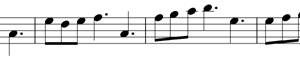
In the Trinity Grade 3 Music Theory Exam, you might be given a short piece of music with about 5 deliberate mistakes in it. You need to rewrite the whole …

Here are the rests you need to know for the grade 3 music theory exam, in order of length, starting with the longest: semibreve – minim – crotchet – quaver …
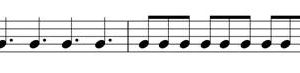
Table of Note Names UK v. USA Simple Time Signatures Up till now you have only learnt about simple time signatures. (Perhaps you didn’t think they were very “simple” though!) …

Tonic Triads The first degree of the scale is also known as the tonic (or “doh”). A tonic triad is a chord built up from the 1st, 3rd and 5th …

Key signatures are written after the clef and before the time signature. Key signatures have to be written very carefully. You need to make sure the flats and sharps are …

The scales of G minor and B minor are tested in the Grade 3 Trinity and ABRSM Music Theory exams. In this lesson we will look two types of minor …
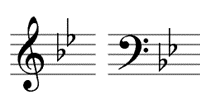
The scales of D major and B flat major are tested in the Trinity Grade 3 Music Theory exam. (With ABRSM D major is grade 1, and Bb major is …

E and A flat major scales are tested in the ABRSM Grade 3 Music Theory exam. You should already be familiar with the scales of C, G, D, A, F, …