Transposing by a 4th or 5th
In this lesson we will learn how to move a tune up or down by the interval of a perfect 4th or perfect 5th. The 5th is the interval of …
Pass Your Music Theory Exam with Confidence!
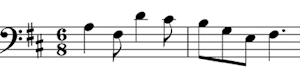
In this lesson we will learn how to move a tune up or down by the interval of a perfect 4th or perfect 5th. The 5th is the interval of …
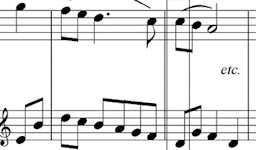
In your music theory exam, you might be given a musical score, with questions about finding or naming intervals in that score. There are a few extra things to keep …

Compound Intervals You should already know how to work out the interval (quality and number) between any two notes that are an octave apart or less. If you need to …

Relative Major and Minor Keys Each key signature represents one major key, and one minor key. These two keys are called “relative” keys – they share a key signature because …

D# Minor The D# minor scales share most of their notes with the F# major scale. Both keys have six sharps in the key signature. Here are the D# minor …

Major Scales All scales have something in common; they have a defined pattern of tones and semitones. All major scales are made up with the following pattern, where T=tone and …
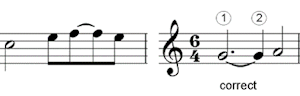
Here is a summary of the most important rules about correct note values, grouping notes with beams, and the choice of rests. The overall principle is to make the beats …

Irregular Tuplets We have already learned that triplets are “three notes in the time of two”, and that duplets are “two notes in the time of three”. In fact, we …
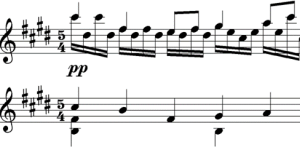
Regular Time All time signatures are either regular or irregular. Regular time signatures have 2, 3 or 4 beats per bar, and the top number is only ever 2, 3, …

The Tenor Clef The tenor clef is a “C” clef, which means it shows us where middle C is written on the stave. We’ve already seen the alto clef (at …