Note Names in Other Languages
Note Names in Other Languages The letter names of the notes A-G which we use in English have different names in other languages. You might see these names written in …
Pass Your Music Theory Exam with Confidence!
Note Names in Other Languages The letter names of the notes A-G which we use in English have different names in other languages. You might see these names written in …
Instrument Families There are four families of instrument. Each family is defined by the way the instruments produce sound. Reed Instruments In the woodwind family, the clarinet, oboe and bassoon …

Cadences “Chord progression” means “series of chords which follow each other”. For example, I-IV-V-I is a chord progression. A cadence is a combination of specific chords which tells the listener …

ABRSM Grade 5 Foreign Musical Terms (Updated July 2020 with the new ABRSM list of terms) For ABRSM Grade 5 Theory, you need to try to learn all the foreign …
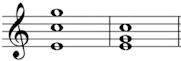
Chord Inversions The simplest way to write a chord is as a triad. A triad is a three-note chord. A chord written like this has its notes as close together …
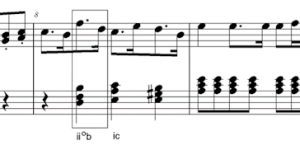
You should already be familiar with the tonic, dominant and subdominant chords/triads. If not, please see Triads and Chords before reading this lesson! The chord built up from the 2nd …
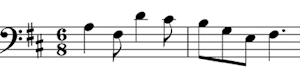
In this lesson we will learn how to move a tune up or down by the interval of a perfect 4th or perfect 5th. The 5th is the interval of …
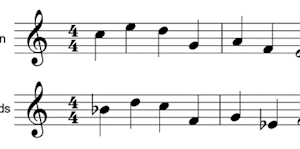
Most clarinets and trumpets are pitched “in Bb”, which means that the sounds produced by the instrument are a major 2nd lower than written. To work out how music written …

What note do you hear when you play this note on the piano? You hear a middle C, of course. But if you play the same note on a clarinet, …
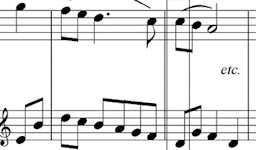
In your music theory exam, you might be given a musical score, with questions about finding or naming intervals in that score. There are a few extra things to keep …