Compound Intervals
Compound Intervals You should already know how to work out the interval (quality and number) between any two notes that are an octave apart or less. If you need to …
Pass Your Music Theory Exam with Confidence!

Compound Intervals You should already know how to work out the interval (quality and number) between any two notes that are an octave apart or less. If you need to …

Relative Major and Minor Keys Each key signature represents one major key, and one minor key. These two keys are called “relative” keys – they share a key signature because …
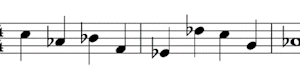
In ABRSM grade 5 theory you are normally asked to work out the key of some music without a key signature. You are given four key options for each melody. …
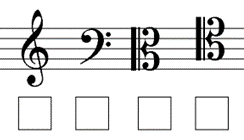
In the ABRSM Grade 5 Music Theory exam you may be asked to identify the correct clef of a scale. The correct clef might be treble, bass, alto or tenor. …

D# Minor The D# minor scales share most of their notes with the F# major scale. Both keys have six sharps in the key signature. Here are the D# minor …

Major Scales All scales have something in common; they have a defined pattern of tones and semitones. All major scales are made up with the following pattern, where T=tone and …

Time Signatures In the ABRSM grade 5 you will usually be given a multiple choice question on time signatures. First, simply add up the notes you can see, as this …
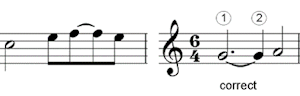
Here is a summary of the most important rules about correct note values, grouping notes with beams, and the choice of rests. The overall principle is to make the beats …

Irregular Tuplets We have already learned that triplets are “three notes in the time of two”, and that duplets are “two notes in the time of three”. In fact, we …
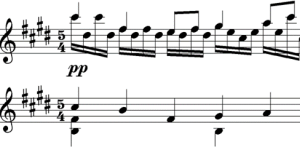
Regular Time All time signatures are either regular or irregular. Regular time signatures have 2, 3 or 4 beats per bar, and the top number is only ever 2, 3, …