Augmented 6th Chords
Augmented 6th Chords There are three chromatic chords which contain the interval of an augmented 6th; the Italian 6th, French 6th and German 6th, collectively known as the “augmented 6th …
Pass Your Music Theory Exam with Confidence!
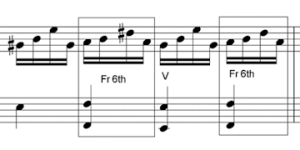
Augmented 6th Chords There are three chromatic chords which contain the interval of an augmented 6th; the Italian 6th, French 6th and German 6th, collectively known as the “augmented 6th …
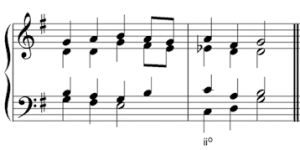
Parallel Keys Parallel keys are the major and minor using the same tonic, for example C major and C minor are parallel keys. Sometimes parallel keys use enharmonic equivalents, to …
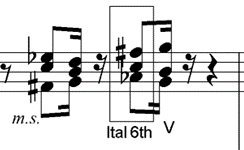
Chromatic Chords Diatonic chords are the ones which are built from the scale of the prevailing key. Chromatic chords use one or more notes which do not exist in the …
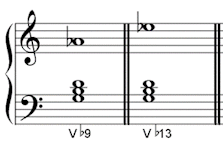
Extended Dominants (V9, V11, V13) The dominant chord can be extended further than the usual addition of a 7th (V7). By continuing to add the note a third higher each …

Free ABRSM Grade 7 Music Theory Test PDF Download a free PDF ABRSM Grade 7 test here. Answers are supplied for Q4 and Q5. For Qs1-3 answers will vary. Free …
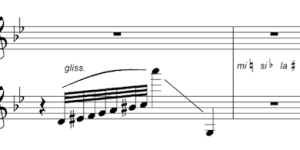
Instrument Specifics In this section we’ll look at some of the instrument specific musical terminology and facts that have appeared in past papers for Grade 7. This is not an …

Although most chords that you are asked to find at Grade 7 are dominant 7ths, diminished 7ths or Neapolitan 6ths, any other “normal” chord could also come up, including added …

The phrase “parts cross” means that between two parts, the higher one moves downward in pitch so far that it becomes the lower one (or the lower part moves above …

Very occasionally, the key you transpose into might be an enharmonic equivalent. For example, a Bb clarinet part originally in the key of Gb major, will end up in Fb …

Question 3b in the ABRSM Grade 7 Music Theory Exam paper is a solo melody composition, with a given opening. In this lesson: Q3b Marking Criteria To gain top marks …