Figured Decoration
From time-to-time unfamiliar figures can appear in figured bass. Most of the time they occur because of decorative notes which are essential to include. Sometimes the figure will include a …
Pass Your Music Theory Exam with Confidence!
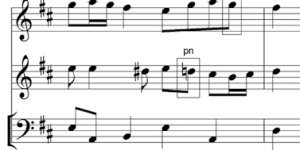
From time-to-time unfamiliar figures can appear in figured bass. Most of the time they occur because of decorative notes which are essential to include. Sometimes the figure will include a …
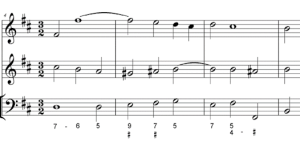
Figure 5 Occasionally you may come across the figure “5” in a figured bass line. Figured bass numbers were originally intended as chord notation for continuo players, who would improvise …
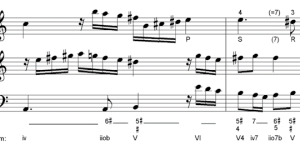
The figure 5/4 should be treated like a 4-3 suspension. Of the two numbers in this figure, the 4th is the suspended dissonant note, and the 5th is the 5th …
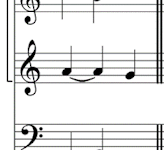
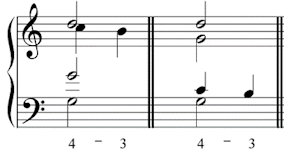
4-3 Suspension The figure 4-3 shows a suspension of a 4th within a root position chord. The 4th then resolves downwards to the 3rd. When you are realising a figured …
The following figures were covered at ABRSM Grade 7. Here is a quick review: 7th Chords The figuring of added 7th chords was covered at grade 7, but here’s a …

Identifying the Prevailing Key To work out the prevailing key at any point in a piece of music, remember that chords generally belong to one of three types: These 2 …
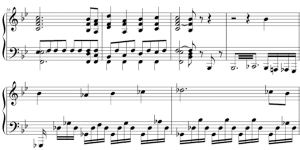
Distant Modulation During the Baroque and early Classical periods most modulations would be to the dominant, subdominant or relative key. Modulation to these “close” keys is relatively straightforward, because two …
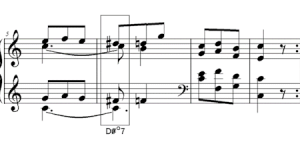
Other Chromatic Chords For each degree of the scale, it is possible to build a major, minor, diminished and augmented triad. So, for example in C major, it is possible …
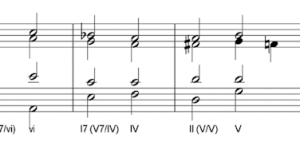
Any major or minor chord can be approached by its own temporary dominant or dominant 7th chord, which is called a “secondary dominant”. The most frequently seen secondary dominant is …
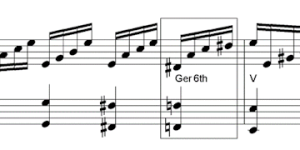
By the time you reach ABRSM Grade 8 Music Theory, the syllabus asks that you understand “all standard diatonic and chromatic chords“. You will need to be able to recognise …