Adding Bar Lines
You might be asked to add bar lines to a short melody or check whether bar lines have been written correctly. The question could look something like this: Add the …
Pass Your Music Theory Exam with Confidence!
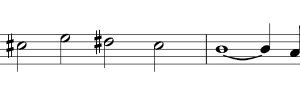
You might be asked to add bar lines to a short melody or check whether bar lines have been written correctly. The question could look something like this: Add the …
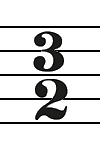
Hover your mouse over the UK note names to see the USA equivalents. In Grade Two Music Theory, we have some new time signatures to look at. The lower number …
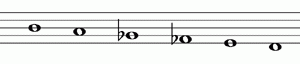
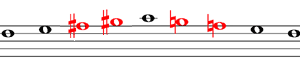
Point your mouse at the stave (tap on mobile devices) to reveal the answers. Adding Clefs and Accidentals 1. Add the correct clef and any necessary sharp or flat signs …

Music which is written in a minor key will usually use a mixture of a key signature plus accidentals. There are no special minor key signatures in music theory- we …

The major scales that we’ve learnt (ABRSM Grade 2) which use sharp key signatures are G, D and A major. The sharps in key signatures are always written in this …
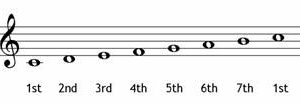
What are the Degrees of the Scale? Degrees of the scale are tested at grade two music theory. Any note of any scale can be given a number as well …
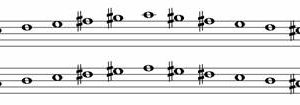
Melodic minor scales are a bit more complicated than other scales, because they have one pattern on the way up, but another on the way down. Melodic minor scales are …
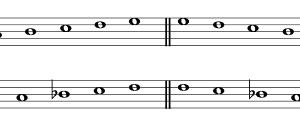
Minor scales sound different to major scales because they are built on a different pattern of tones (whole steps) and semitones (half steps). Many people think that minor scales sound sad, …
Major Scales Major scales are built from tones and semitones, with the pattern TTS TTTS. (T=tone (whole step), S=semitone (half step)) You should already know the scales of C, D, …
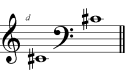
In this lesson we will learn how a melody can be written in a different clef – from treble to bass or from bass to treble, without changing the pitch …