Decoration Mistakes to Avoid
Consecutives Consecutive 5ths and octaves must be avoided between chords when you are writing traditional harmony. If the music contains melodic decoration like passing or auxiliary notes, then you also …
Pass Your Music Theory Exam with Confidence!

Consecutives Consecutive 5ths and octaves must be avoided between chords when you are writing traditional harmony. If the music contains melodic decoration like passing or auxiliary notes, then you also …

When decorative non-chord notes (e.g. passing notes or auxiliary notes) are used in two or more parts at the same time, it’s best to make sure that the decoration notes …
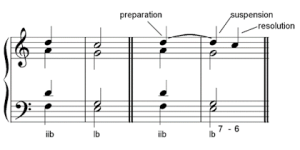
Suspensions are prepared, dissonant non-chord notes which resolve downwards by step. They fall on a strong beat, but are not normally accented in themselves, because they are usually tied backwards …
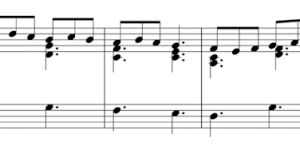
Auxiliary Notes Auxiliary notes are non-chord notes which are approached and quit in the opposite direction by step. They are usually unaccented. They can either be upper or lower auxiliary …
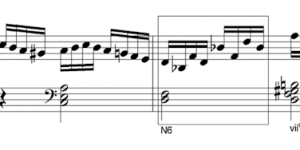
One of the most commonly-used chromatic chords in the Classical period (and beyond) is the Neapolitan 6th chord, or “N6”. This is a major chord, built from the flattened supertonic …

The chords ii7 and vii°7 are in a group of chords called secondary 7ths. A secondary 7th is an added 7th chord built on any degree of the scale except …

Chord vii°7 Chord vii°7 is a diminished 7th chord. It is built from the diminished triad on the 7th degree of the scale, plus another third added on top: the …
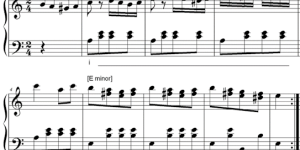
Modulation is the process of changing key. Although most modulations use the progression V-I or V7-I, sometimes music can pass into a new key without any preparation from the new …
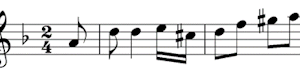
Key ID and Chromatic Notes The key signature at the start of a piece of music represents one major key, and one minor key. To work out whether the piece …
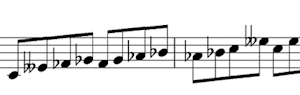
The Whole Tone Scale The whole-tone scale is a six-note scale, where each note is a tone (whole step) higher/lower than the next. There are two varieties: Since the interval …