Grade 5 Music Theory Test (ABRSM)
Test your skills and knowledge of Grade Five Music Theory with this free online practice test below! Or download a free PDF test here! The questions are based on …
Pass Your Music Theory Exam with Confidence!

Test your skills and knowledge of Grade Five Music Theory with this free online practice test below! Or download a free PDF test here! The questions are based on …

The symbols for ornaments were introduced at grade 4. You should already be familiar with the trill, mordent, acciaccatura, turn, appoggiatura and grace notes. The task of “writing out ornaments …

Chromatic Passing Notes Chromatic passing notes are passing notes which do not belong to the current key. They normally occur between two notes which are a tone apart, filling in …

A “pedal” is a note which is repeated or held for some time, while the chords around it change. Pedals are normally found on either the tonic or dominant notes. …

The term “changing note” is used to describe a variety of non-chord note patterns. What they have in common is that the non-chord note is unaccented, and the figure employs …

An anticipation is an unaccented non-chord note which is an early sounding of the following chord note, which is then repeated within its own chord. For example, the soprano chord …

Appoggiaturas are accented non-chord notes which move by step (up or down) to a chord note to resolve. In this example, the chord is C major. The note D is …
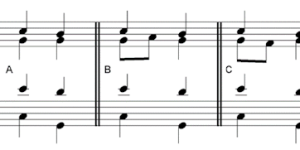
Ordinary Auxiliary Notes Auxiliary notes are non-chord notes which are approached and quit in the opposite direction by step. They are usually unaccented. Auxiliary notes occur between two chord notes …
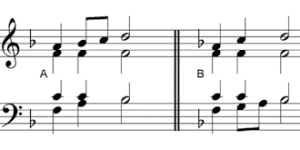
Accented passing notes fall on the beat, instead of between the beats. Here are some undecorated chords. There are thirds in the soprano part which could be decorated with unaccented …
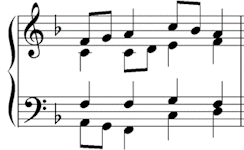
Passing notes are non-chord notes which are approached and quit by step in the same direction. They can be either accented or more usually, unaccented. Unaccented passing notes are the …