Last Updated on 3 September 2023 by Victoria Williams
Augmented 6th Chords
There are three chromatic chords which contain the interval of an augmented 6th; the Italian 6th, French 6th and German 6th, collectively known as the “augmented 6th chords”.
Augmented 6th chords have as their root note the raised 4th above the tonic, e.g. F# in the key of C major or C minor. This note is the leading note to the dominant (F#àG), and the chord behaves like a secondary dominant (Aug6àV).
The chords are usually (but not exclusively) written in first inversion.
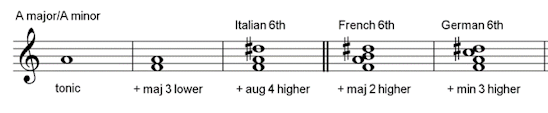
To build an augmented 6th chord:
- take the tonic note of the prevailing key,
- add the note a major third lower, (you will need an accidental in major keys) and
- the note an augmented 4th higher (accidental always needed).
These three notes create the “Italian 6th” chord.

The distance between the bass note (Ab) and the root (F#) is an augmented 6th.
Adding a 4th note which is a major 2nd higher than the tonic note creates a “French 6th”.

Adding a 4th note which is a minor 3rd higher than the tonic creates a “German 6th”.
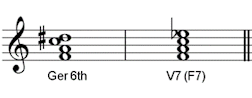
The German 6th is an enharmonic equivalent of the dominant 7th chord – the same notes but spelled differently. For example, the German 6th in A minor (see above) is a re-spelling of the dominant 7th chord in Bb major:
Tip: To remember the names of the augmented chords, think of the geography of the countries. Italy is furthest south, and has 3 notes. France is more northern (up) and has a higher additional note. Germany is more northern still, and has the highest additional note.
Examples of all three augmented 6th chords can be found frequently in Classical music and onwards (1750+), but these chords are less used in older (Baroque) styles.
Italian 6th in Mozart’s Fantasy in C minor (K475):

French 6ths in Mozart’s Sonata in Am (K310):

Notice how the bass moves up/down by a semitone.
German 6th in the same sonata:

Notice how the bass moves down chromatically through G-F#-F-E.