Last Updated on 29 April 2026 by Victoria Williams
ABRSM
The ABRSM (Associated Board of the Royal Schools of Music) is the market-leading music exam board in the United Kingdom. The ABRSM’s main competitor is Trinity College of Music. Apart from providing practical and theory exams in more than 90 countries around the world, it is also a publishing company and a training provider.
The ABRSM publishes sheet music, books, exam papers and syllabuses, and runs training workshops for music teachers worldwide. The ABRSM is not affiliated to My Music Theory in any way.

The UK music exam system comprises eight graded levels which take you from beginner level up to the standard required for university entrance on a Music Degree. (Entrance to a Conservatoire is very competitive and may require a skill level above grade 8).
Beyond grade 8, there are three levels of diploma which are awarded credits at level 5 (1st year degree equivalent), level 6 (degree equivalent) and level 7 (masters degree equivalent).
Music exams can be taken in all orchestral instruments and voice, plus some non-orchestral instruments such as the recorder, saxophone or ukulele.
ABRSM Music Theory Today
Currently the ABRSM offers music theory exams up to grade 8 level. (There is no initial grade).
Grades 1-5 are available as online exams and can be taken at any time, from the comfort of your own home.
Grades 6-8 are paper-based exams which are taken at an external exam centre. In the UK there are three sessions per year, in Spring, Autumn and Summer. Check the ABRSM website for dates. www.abrsm.org
MyMusicTheory offers complete video courses from Grade 1 up to Grade 8. See https://mymusictheory.newzenler.com/ for more details!
Grades 1-5 covers basic music literacy – notation, time signatures, key signatures, scales, simple chords and cadences and intervals. The exam format is multiple-choice. There is no minimum age, and with coaching children as young as 6 have passed comfortably. However, most children attempt grade 5 when at secondary school. There is no upper age limit!
Grades 6-8 are a completely different type of exam and require you to write music for 50% of the exam paper – composition and harmony skills are tested, along with more in depth skills of analysis. Grade 6 is usually suitable for age 16+, but occasionally younger children manage it. In years gone by, grade 6 theory was a requirement for those taking the DipABRSM teaching diploma. If you are a teacher, grade 6 (and beyond) are still very useful goals to study for.
The ABRSM’s approach to music theory is quite traditional. It is the exam board favoured by conservative (with a small c!) teachers and communities who value tradition above innovation. There is a strong focus on Classical music and no expectation for the student to compose or write harmony in a modern style or for non-orchestral instruments. Compare this with Trinity, whose syllabus includes non-Classical harmony such as folk music modes, serialism, whole tone and pentatonic scales, and requires an understanding of non-orchestral instruments such as the guitar, saxophone and recorder families.
The ABRSM requires Grade 5 Music Theory as a pre-requisite for those wishing to take grade 6 or higher in an instrument or voice (some alternative qualifications are allowed – check the ABRSM website for details). For this reason, it is the most “popular” of the theory exam grades. The multiple-choice aspect of the ABRSM Grade 5 exam makes it relatively easy to pass, once the basic concepts have been learned.
ABRSM Statistics
NB The ABRSM does not seem to publish music theory exam statistics any more – these are the latest figures I have found.
| 2012 | |||||
|---|---|---|---|---|---|
| Grade | Pass | Merit | Distinction | Fail | Total |
| 1 |
776
|
1,817
|
3,909
|
255
|
6,751
|
| 2 |
147
|
588
|
1,414
|
147
|
4,410
|
| 3 |
1,461
|
1,607
|
730
|
523
|
4,321
|
| 4 |
621
|
846
|
636
|
166
|
2,269
|
| 5 |
7,285
|
7,474
|
3,772
|
3,036
|
21,567
|
| 6 |
388
|
152
|
27
|
235
|
802
|
| 7 |
100
|
81
|
11
|
21
|
213
|
| 8 |
139
|
65
|
11
|
97
|
312
|
| 40,645 | |||||
| 2006 | |||||
|---|---|---|---|---|---|
| Grade | Pass | Merit | Distinction | Fail | Total |
| 1 |
909
|
2,116
|
4,512
|
255
|
7,792
|
| 2 |
478
|
1,269
|
3,317
|
73
|
5,137
|
| 3 |
1,330
|
1,714
|
1,523
|
570
|
5,137
|
| 4 |
660
|
974
|
867
|
138
|
2,639
|
| 5 |
8,543
|
6,777
|
3,122
|
3,405
|
21,847
|
| 6 |
377
|
159
|
57
|
209
|
802
|
| 7 |
94
|
46
|
15
|
26
|
181
|
| 8 |
119
|
59
|
18
|
77
|
273
|
| 43,808 | |||||
ABRSM Music Theory of Yesteryear
It seems the first Music Theory exams were introduced by the ABRSM (then known as “The Associated Board of the Royal Academy of Music and the Royal College of Music”) in the 1890s. As someone who has been obsessed by music theory for most of my life, I can’t resist picking up old past papers when I come across them. The earliest I have is from 1913.
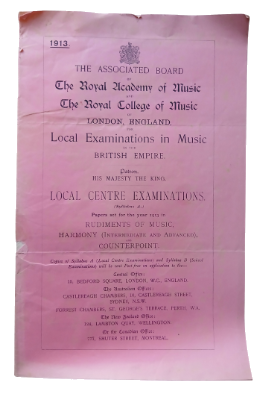
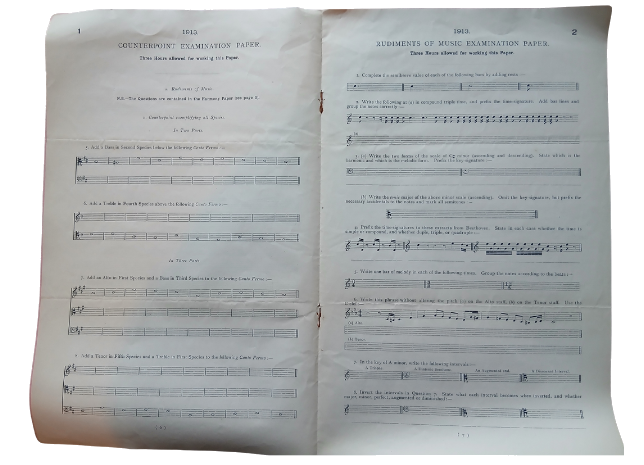
The 1913 exams were available for “Rudiments of Music, Harmony (Intermediate and Advanced) and Counterpoint, which sort of equates to four grades in total.
The Rudiments paper is not a beginner level exam – the candidate is expected to know the four clefs, keys up to at least 6 sharps/flats, transposition at any interval, writing out ornaments (“exactly as they should be played”!), so I would say it is between the current grade 5 and grade 6.
Intermediate Harmony includes many of the same type of exercises (inserting time signatures, writing out ornaments, transposition of clefs etc.) but also requires writing SATB 4-part harmony, harmonising in tonal sequences, added 7th chords, and realising a figured bass (this exercise is considerably longer than the one currently set at grade 6).
The Advanced Harmony requires four-part SATB harmonisation with modulation in both chorale and piano style. The candidate is also asked to add three parts above a given figured bass. There are questions on a set text (such as Beethoven’s Sonata Op.27 no.2 which required a fairly detailed analysis, including identification of the subjects, modulations, sonata sections, and harmony.
Finally, the Counterpoint paper comprises 4 questions in 2- or 3- parts against a given Cantus Firmus, using the principals of Species Counterpoint. See Counterpoint if you’d like to know more about this!
In 1933 the ABRSM restructured the exam system, possibly due to a demand for exams more suitable for beginners. Eight grades were introduced:
- Grade 1 (Primary)
- Grade 2 (Elementary)
- Grade 3 (Transitional)
- Grade 4 (Lower)
- Grade 5 (Higher)
- Grade 6 (Intermediate)
- Grade 7 (Advanced)
- Grade 8 (Final)
The alternative names were phased out in the 1960s.
ABRSM Music Theory in the Last 50 years
When I took my Grade 5 Theory back in the 1980s, the syllabus requirements were quite a lot more involved than the current ones.
Composition of an answering phrase melody was compulsory (no longer included), and every candidate dreaded the possibility of getting a “writing out ornaments” question (now at grade 6)! Transposition was of an entire melody (now just a bar’s worth), and triads had to be written out (in pencil of course) in full (now students drag and drop notes on a stave).
We had to write out four-part chords, and face transposition at any interval (e.g. an augmented 4th) (current students have to transpose by a major 2nd, minor 3rd or perfect 4th/5th).
There was also a high possibility of having to write a rhythm to a given poetic couplet (no longer included). The exam time limit was 2 hours.
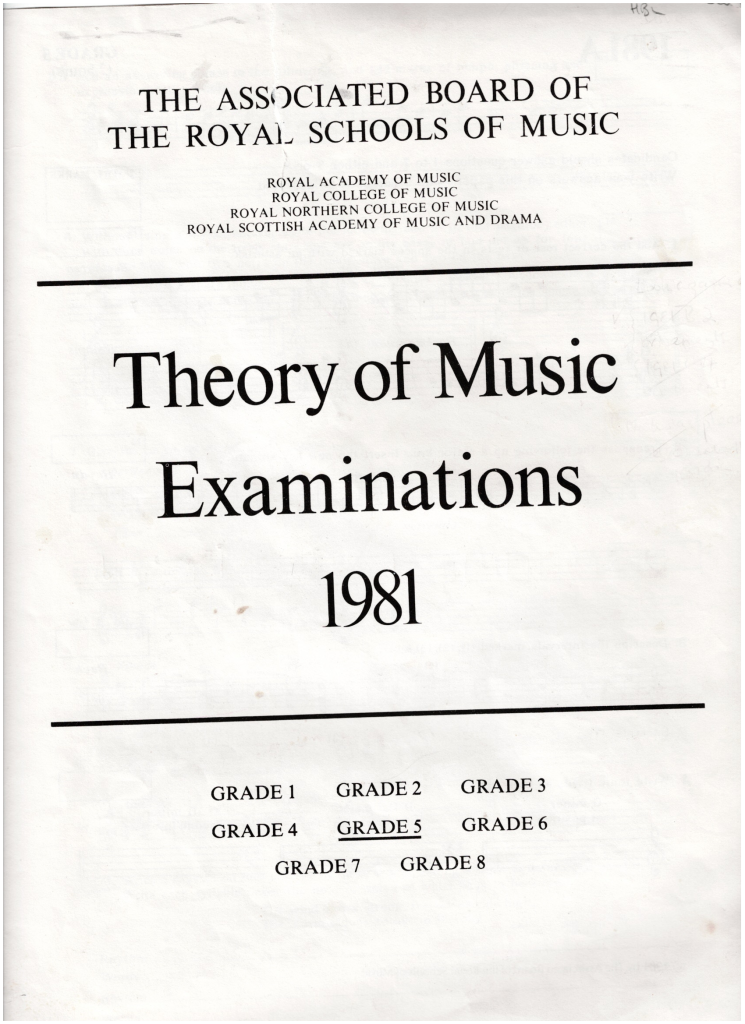
I sat my Grade 5 Theory at Sutton Girls School in Sutton Coldfield. I finished the paper in 30 minutes but was terrified to leave early in case I drew attention to myself! I sat there until someone else left early, then made my way home. In those days the paper was scored out of 99 and my score was 98. I still wonder where I lost the 1 mark! I think we had to wait a considerable number of weeks for the results to be released.
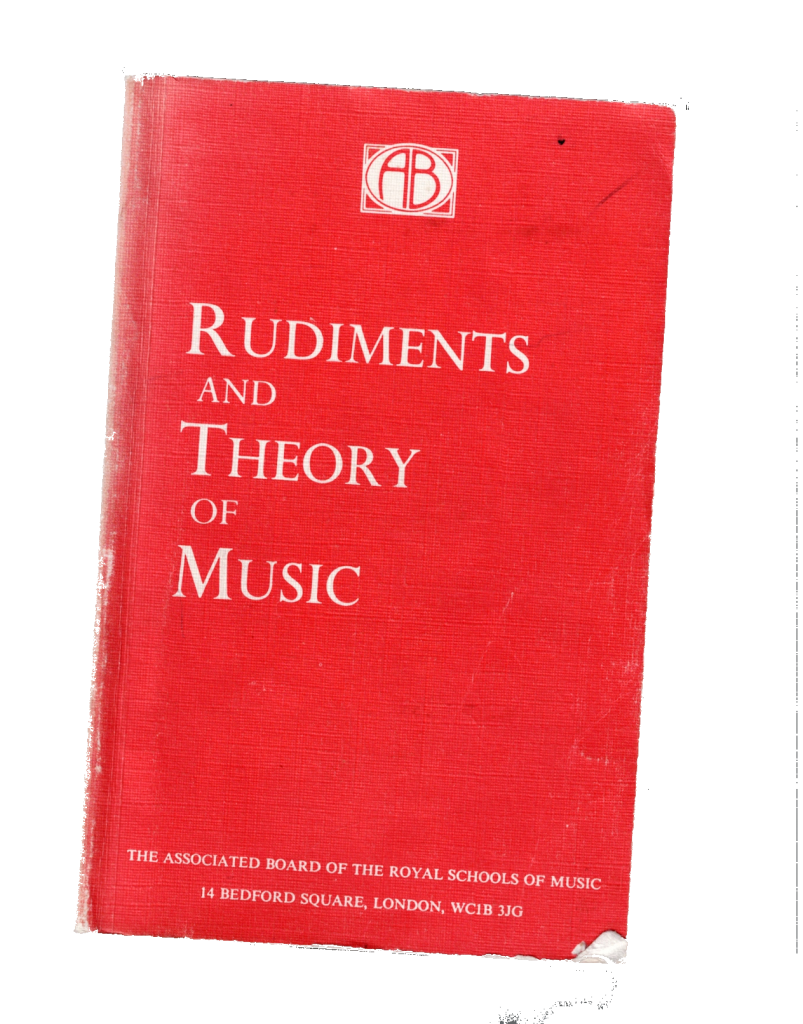
Everybody at this time relied on the “Little Red Book” – The AB’s “Rudiments and Theory of Music”. This is a photo of mine, which I still treasure! I numbered the foreign terms at the back of the book – there were 291 in total for grade 5!
The exams stayed broadly the same at the start of the 21st century, although the question styles began to be clearer with fewer “essay-style” questions at the higher grades. Exam papers became better laid out, less cluttered with clearer fonts.
Then in 2018 the ABRSM did their first large-scale overhaul of the exams for some decades. Grades 1-5 had the compositional element completely removed, and the long lists of foreign terms my generation had been subjected to was pared down to a handful of essentials. I think removal of composition was an enormous error, personally. Foreign terms I am less passionate about – we all have dictionaries!
When Covid and the lockdown hit in 2019, the ABRSM had to adapt quickly. At this point they rolled out a beta version of their new online exam. This beta version was sold at full price to candidates, despite the fact they were acting as guinea pigs! All candidates sat the first online exam at exactly the same time. The (somewhat predictable result) was that the system crashed and children around the UK were left in tears as their PCs froze and connections were lost. The PR collateral damage was substantial and it should be remarked that unfortunately the ABRSM did not handle complaints in a sensitive manner. Many parents and teachers at this point decided to migrate to Trinity,
Now the dust has settled and online exams have become the norm, not the exception. The ABRSM has improved its platform. Perhaps there is still a possibility that it will bring back composition and more rigorous harmony into the grade 5 exam?