Last Updated on 29 April 2026 by Victoria Williams
Pitch
We talk about musical sounds as being high or low pitched. If you look at musical instruments, you’ll see that bigger instruments make lower sounds, and smaller instruments make higher ones, and that’s also why women and children usually have higher voices than men. But have you ever wondered why we use the words low and high for sound, when sound itself is … invisible?
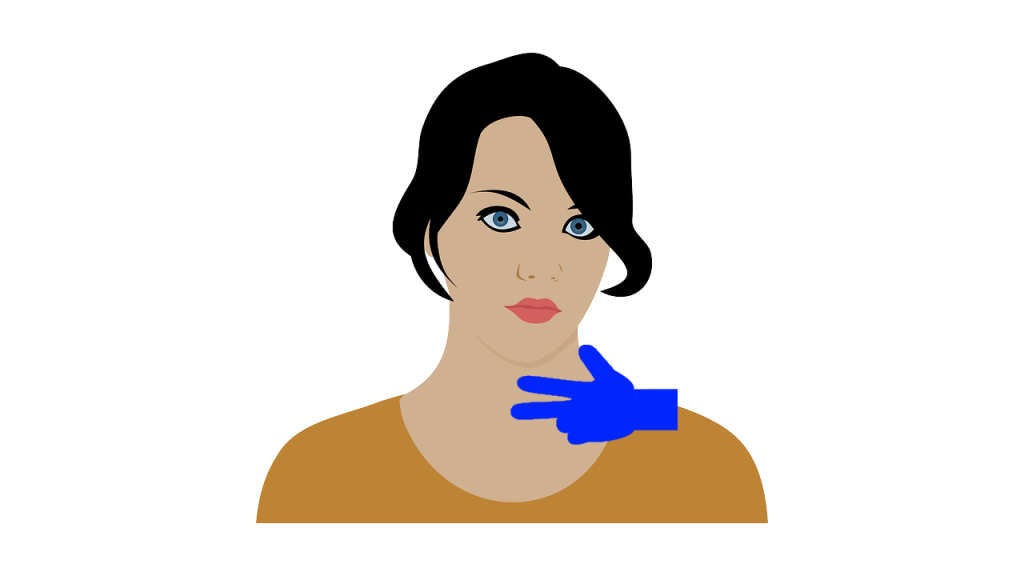
Try this experiment – put two fingers lightly on your Adam’s apple and hum the lowest note you can manage. Keep your fingers there, then change to the highest note you can manage. You should be able to feel your Adam’s apple jump up to a higher position in your throat, and this physical sensation is connected to the words we use for describing the pitch of a sound.
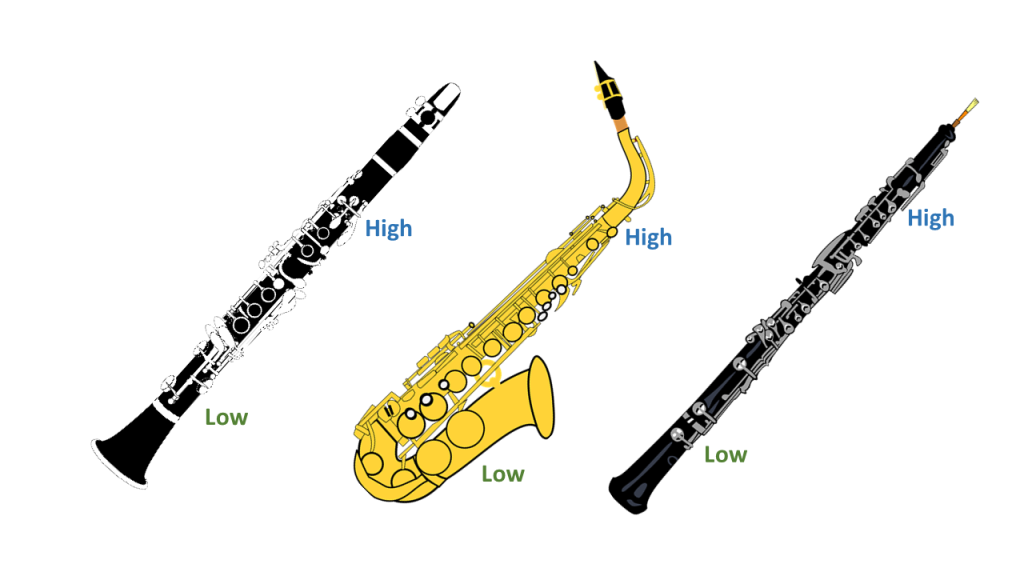
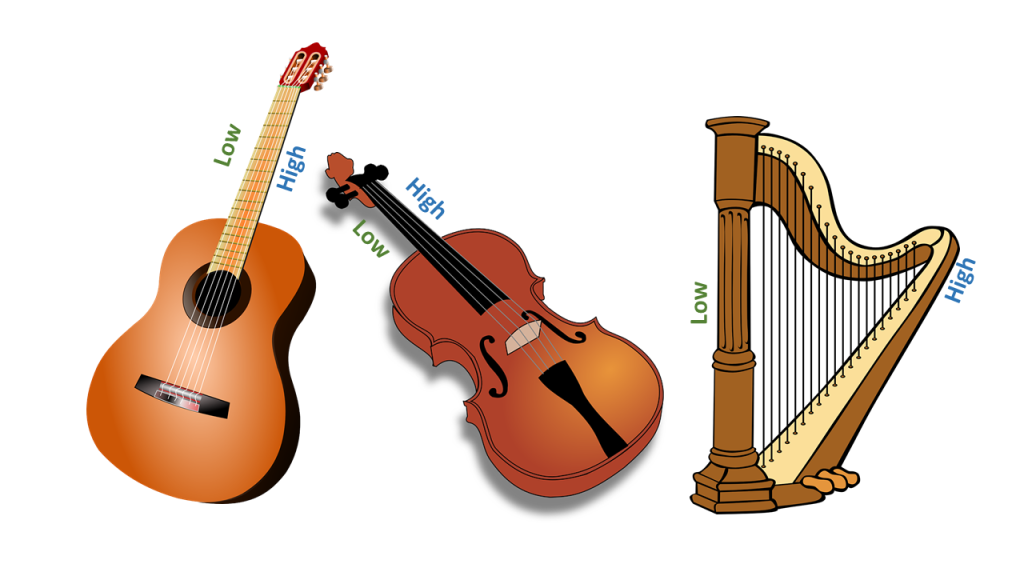
Musical instruments work in similar ways – they normally have a low end, which is the bottom of the instrument, and a high end, which is the top. String instruments like violins, guitars or harps have their strings strung in order from low to high – the lower strings are longer or thicker, or both. (The ukulele is an exception). The piano runs from low on the left, to high on the right, and holes in wind instruments basically just change it from a long tube, (which makes low notes), to a shorter tube, (which makes higher ones). Brass instruments work in a slightly different way, however.
When you sing or play an instrument, you are actually making the air vibrate. Your ear detects the vibrations and your brain converts the vibrations into sound. Those vibrations can be measured, by looking at how many happen per second. When you play the note A – the one that orchestras normally tune up to – there are 440 vibrations per second. The unit of measurement for pitch is called the Hertz, so this A is 440Hz. The pitch of the note is the same, whether it’s sung, played on a piano,… guitar, … trumpet or anything else.
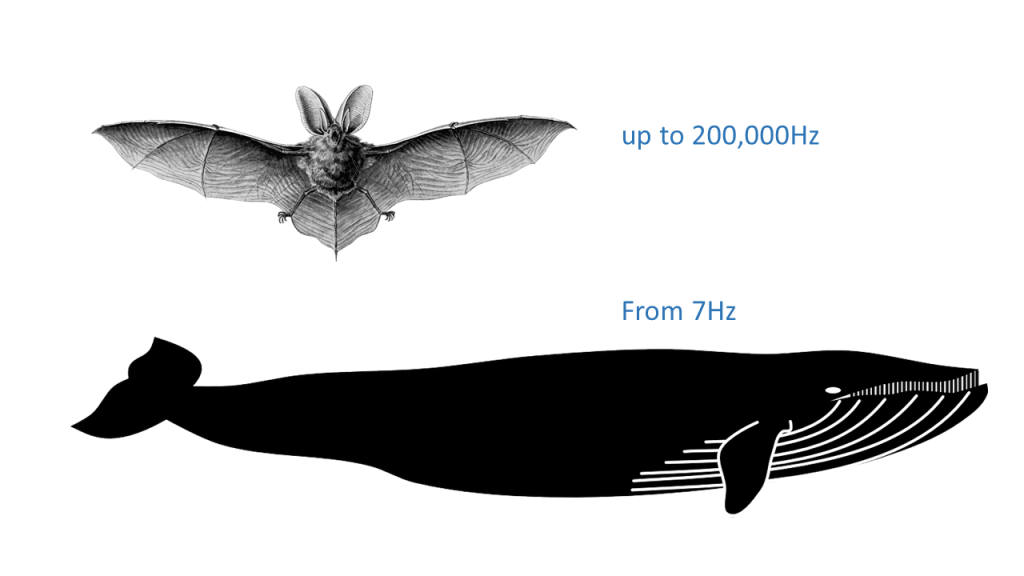
The healthy human ear can hear from about 20 hz at the low end to 20,000hz at the high end. That might sound a lot, but we’re still missing out on a lot – bats can hear up to 200,000 hertz for example, and whales can hear as low as 7.
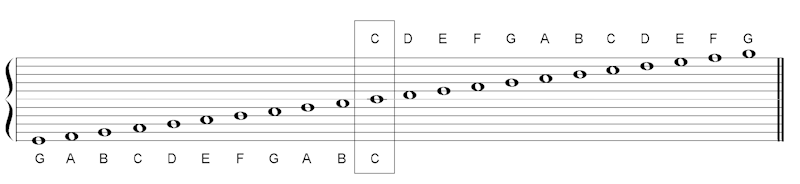
So, because we perceive sound as ranging low or high, musical is most often written down using a system which shows the relative height of each note.
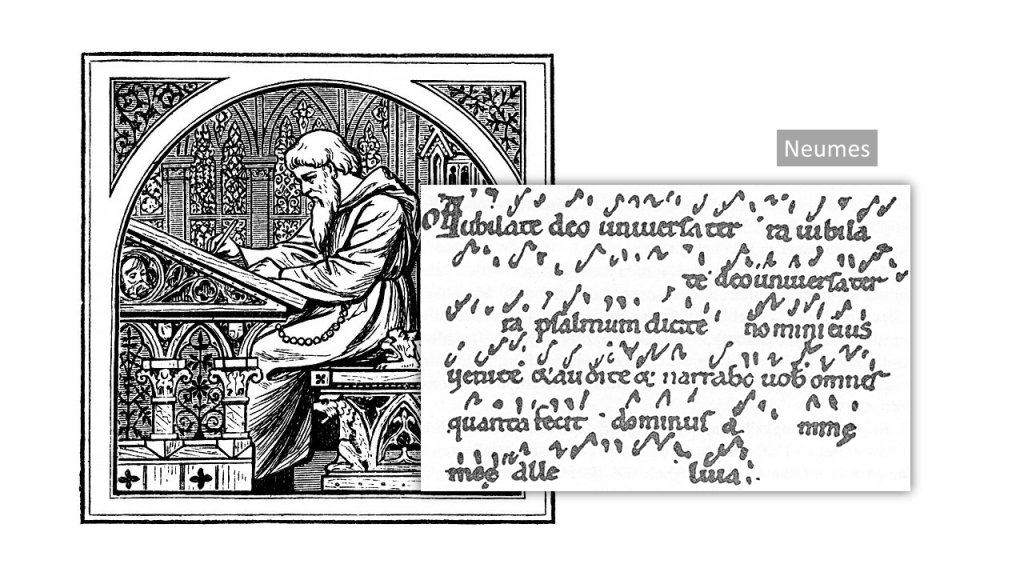
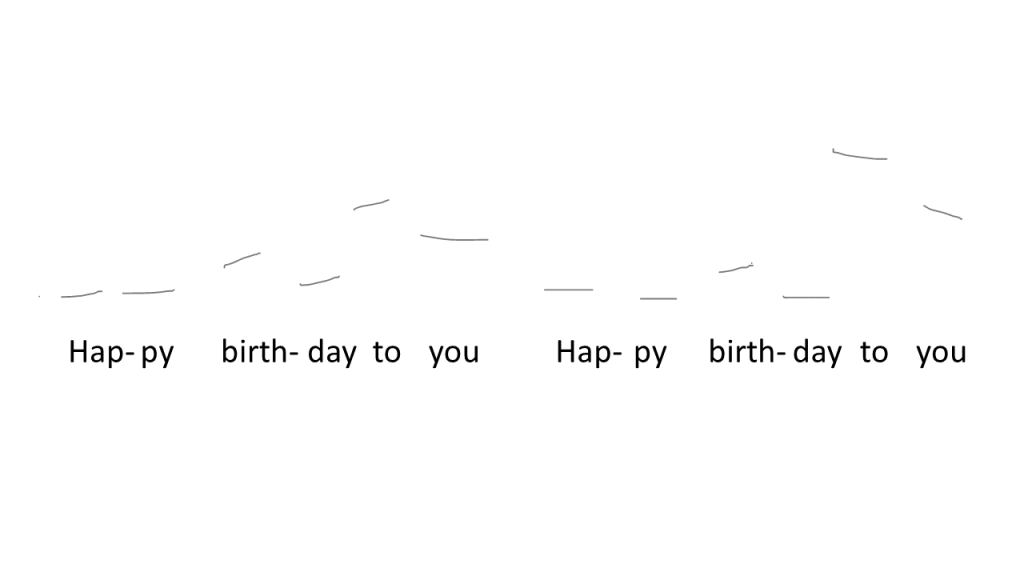
Some of the earliest ever written music was done by monks in the Medieval days – until that point in history music had just been passed down the generations by memory and repetition, so the monks had to invent a system of notation for themselves. They began by only marking out pitch – not rhythm, and they didn’t have a way to show exact pitch, only the general musical shape – so whether the next note was a bit higher or a bit lower. This system was called neumes, and really it was only useful for jogging a musician’s memory, if they’d forgotten a tune. You can’t look at a piece you’ve never heard before, written in neumes, and know exactly what it’s supposed to sound like.
If you were going to write Happy Birthday in neumes, it might look something like this:
Obviously it got a bit frustrating trying to read neumes, because the monks pretty soon started ruling lines and writing notes on the lines, to make it clearer what the pitch of the notes should be.
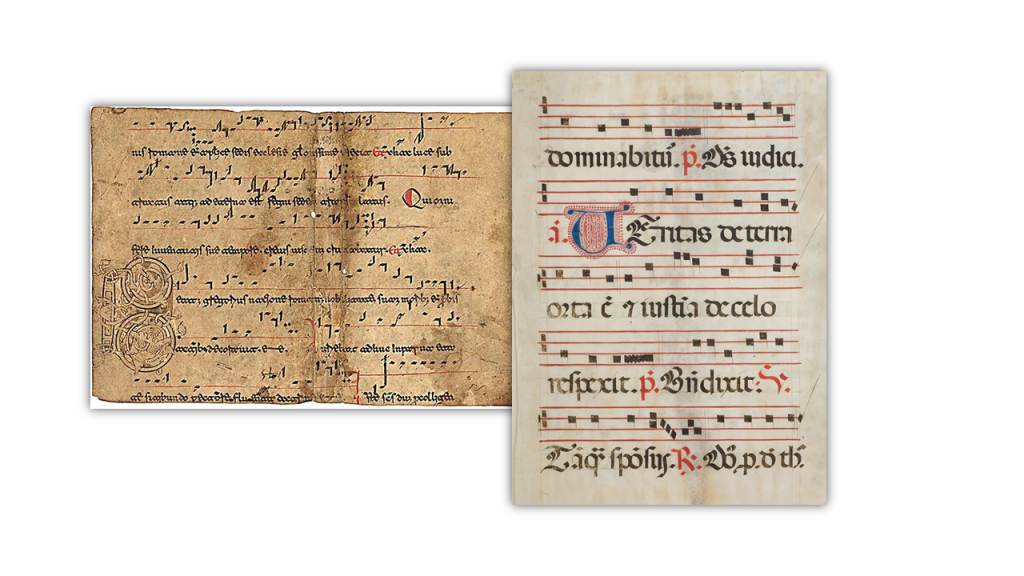
For quite a while there was no standard number of lines – it might be 4, or 6 for example, but eventually they settled on 5 lines, because if you use the spaces under and above each line, and each line itself, it gives you enough room for 11 notes, … which is about what the average person can comfortably sing and read from.
Obviously it got a bit frustrating trying to read neumes, because the monks pretty soon started ruling lines and writing notes on the lines, to make it clearer what the pitch of the notes should be.
For quite a while there was no standard number of lines – it might be 4, or 6 for example.
But eventually they settled on 5 lines, because if you use the spaces under and above each line, and each line itself, it gives you enough room for 11 notes, … which is about what the average person can comfortably sing and read from.
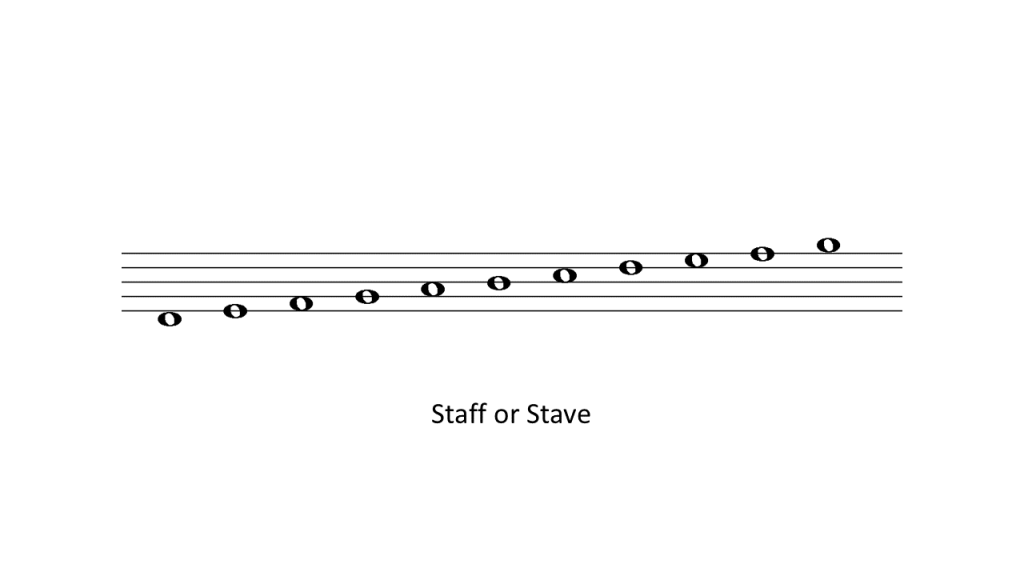
These five lines are still in use today. We call it a staff, or in Britain it’s also called a stave.
The 5-line staff can show you the exact pitch of the notes you want to play, but to do that, you first need to decide which particular notes your staff is going to hold, and to do that, you need something called, a clef!
Read more about clefs here: Pitch & the Treble Clef
Learn More About Pitch
If you’d like to learn lots more about pitch, please consider joining one of my Video Courses! We start with the basics of pitch notation in Grade 1 Music Theory. See the Course here: